


Introduction
Breastfeeding doesn’t always come easily. It’s normal for it to take time (and plenty of practice!) before you and your baby find your rhythm.
If you’re having a wobble, don’t worry, we have lots of helpful tips and techniques that can help. While it might feel frustrating or even painful at first, once you both get the hang of it, breastfeeding can be deeply rewarding and a wonderful way to bond with your baby.
Why are my nipples sore when breastfeeding?
The sensation of breastfeeding can take a bit of getting used but it shouldn’t be painful. If you’re experiencing sore nipples, it could be because your baby isn’t in the correct position and hasn’t latched on properly.1 You could try using a nipple cream or expressed breast milk between feeds to soothe any pain or dryness.
If you’re in pain, it’s important to get help as soon as possible, as trying to push through could make things worse and lead to issues like breastfeeding mastitis. It’s important not to give up, so chat to your midwife, health visitor or GP who can help you find the correct position and make feeding more comfortable.
Painful, cracked, or bleeding nipples are all signs to ask for help as soon as possible.
What can I do if I don’t think I’m producing enough milk?
Thinking you’re not producing enough milk is a common worry among new mums, but knowing the signs that your baby is getting enough can help.
It’s important to offer your baby both breasts at each feed – alternating which breast you start with helps stimulate your milk supply.
Signs your baby is getting enough milk:
- You can hear it – you can see and hear your baby steadily sucking and swallowing with rounded cheeks
- Your baby is content – your baby comes off the breast on their own when they’re done and seems calm and relaxed
- A milky mouth – your baby’s mouth is wet, your breasts feel softer, and your nipples are the same shape they were before the feed
- Weight gain and wet nappies – your baby steadily gains weight after the first two weeks, stays alert when awake, has soft yellow poos from day 4 and from day 5 has at least 6 wet nappies a day2
Things that can boost your milk supply:
- Asking for help – your midwife or health visitor can offer guidance and support if you’re finding breastfeeding tricky
- Feeding often – be guided by your baby – let them feed as often as they want for as long as they want
- Expressing – gently removing milk from your breast with your hand or a pump after feeds (once breastfeeding is established) – can help stimulate your milk supply
- Keeping your baby close – skin-on-skin contact can help encourage milk supply
Things that can lower your milk supply:
- Your baby is not latching on correctly
- Giving infrequent feeds or just focusing on one breast
- Smoking/alcohol/certain medication
- Stress
- If your baby is tongue-tied
- Giving your baby formula or a dummy before breastfeeding is properly established
What does breast engorgement feel like and how can I relieve it?
Breastfeeding aches often occur due to engorgement. Engorgement happens when your breasts get overly full – making them feel hard, tight and sore, especially when your milk first comes in.
It tends to happen in the early days when you and your baby are still finding your feet. Feeding your baby helps, however, engorgement can make it harder for your baby to latch on properly and get all the milk easily. If you’re having trouble, chat to your midwife or health visitor as soon as you can.
Ways to ease engorgement:
- Feed often – feeding your baby often and hand expressing a small amount of milk before you feed can relieve the pressure
- A warm cloth – placing a warm cloth on your breasts or taking a shower or bath before expressing can help get milk flowing
- The right bra – choose a comfy, non-restrictive breastfeeding bra
- Pain relief – taking a recommended dose of paracetamol or ibuprofen is safe during breastfeeding and can help with pain3
Why is my baby struggling to latch properly?
Breastfeeding is something you and your baby have never done before, and it may take a little longer than you think to find out what works for you both. If your baby is struggling to latch on they might just be in the wrong position.
How to help your baby latch on:
- Hold your baby close with their nose lined up with your nipple
- Let their head tip back slightly so their top lip brushes your nipple, and they open their mouth wide
- As they open their mouth, bring them to your breast – chin first – so they take a deep mouthful, not just the nipple
- This helps your nipple sit comfortably in the soft part of their mouth
Signs the latch is good:
- It feels comfortable, not painful
- More of your areola (circular part that surrounds the nipple) shows above their top lip than below
- Their mouth is wide open, their lower lip is turned out, and their chin is touching (or nearly touching) your breast4
For more guidance on how to breastfeed read our article.

Can I have too much milk? What are the signs and what can help?
Yes, occasionally, women make too much breastmilk and although this might sound like a good thing, it comes with its own challenges.
Some common signs you’re making more milk than your baby needs:
- Your baby is restless during feeding, may cry or pull on and off the breast
- Your baby coughs, chokes or splutters during feeds
- Your baby clamps down on your nipple (to slow the flow of milk)
- Every feed feels like a battle
- Your baby has green, loose, or explosive poos
- Your breasts never feel fully empty and refill very quickly after feeding
- You’re frequently suffering from blocked ducts or mastitis5
Your midwife or health visitor can help identify why this is happening and suggest ways to decrease your supply.
What is a blocked milk duct and how do I treat it?
A blocked milk duct happens when one part of the breast isn’t draining properly. It can often be caused when your baby hasn’t latched on correctly and can show itself as a small, tender lump.
Ways to treat a blocked milk duct:
- Keep feeding from the affected breast as often and as long as the baby wants
- Use a warm cloth or take a shower before feeds – the heat can help milk flow
- Massage the lump gently towards the nipple while your baby feeds
- Use a cool cloth between feeds to ease any discomfort
- Avoid tight bras and clothing, so your milk can flow freely
Keep an eye on it and if it doesn’t improve quickly, chat to your midwife, health visitor or GP – if left, it could lead to mastitis.6
“Breastfeeding hasn’t been as simple as I imagined — we’ve had sore days, tricky latches and a few tears along the way. But when things start to click, it reminds me why I wanted to keep going. When it works, those quiet little moments with my baby make all the effort feel completely worth it.”
What are the symptoms of mastitis and when should I get help?
If your breasts feel hot and swollen, and you notice a painful red or darker patch, you could be suffering from mastitis. It often occurs within the first three months after giving birth.
Mastitis is an inflammation in the breast. It’s most common in women who are breastfeeding and it can happen when a blocked milk duct doesn’t clear or when a build-up of milk causes swelling or inflammation. The symptoms can come on quite quickly, normally appearing in one breast and it can make you feel like you have the flu.
If you think you’re developing mastitis, contact your midwife, health visitor or GP. You can also check out our article on mastitis prevention for some soothing tips.
How does tongue-tie affect breastfeeding and what can I do?
Some babies are born with tongue-tie – a tight or shortened piece of skin under the tongue that affects how the tongue moves. It’s fairly common (around 1 in 10 babies), and while many aren’t bothered by it, others can struggle with feeding.7
Check out our baby tongue-tie article to find out more about how tongue-tie can affect your baby and how it’s treated.
When should I ask for breastfeeding support?
Breastfeeding can be tough in the early days, so if you have any issues, contact your midwife or health visitor as soon as you can.
Knowing it can take time can be reassuring, but if you’re dealing with symptoms like soreness during breastfeeding, or swollen breasts, don’t ignore them – these issues can worsen if left untreated. The earlier you ask for help, the sooner you’ll feel more comfortable.
For practical guidance or advice, try our Midwife live chat service. Available Monday to Friday 10am to 8pm.
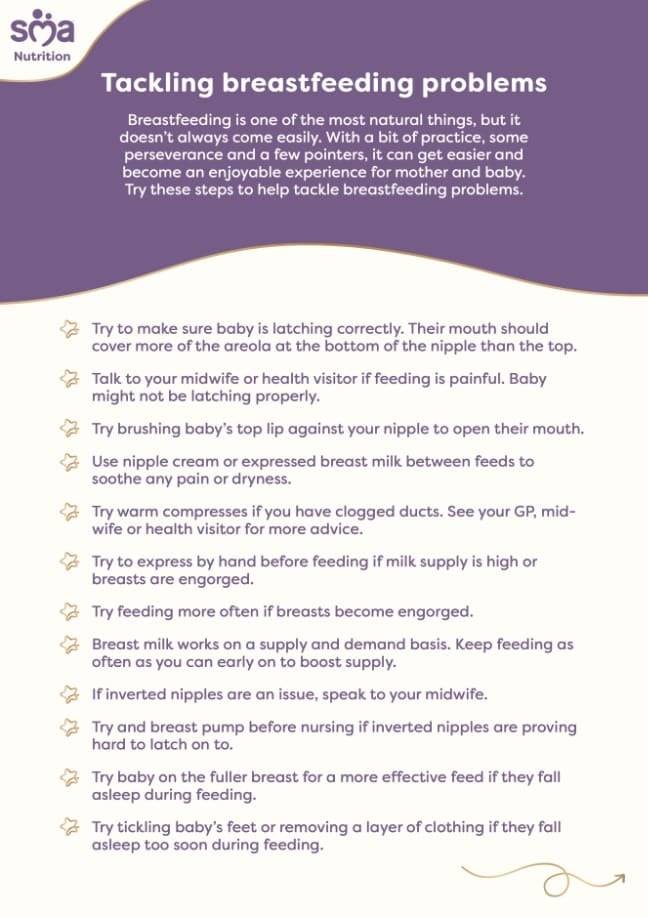
Read our checklist on tackling breastfeeding challenges
Is it okay to stop breastfeeding if it’s not working for me?
Stopping breastfeeding earlier than you hoped or not being able to start can bring a range of emotions, and that’s completely normal. Feeding journeys don’t always go to plan, often because of things you can’t control, like medical issues, short maternity leave, or limited support. Or maybe it’s just not for you. If you want to stop breastfeeding, it’s your choice. Before making any decisions, it’s important to ask for help from your midwife, health visitor or a breastfeeding specialist as soon as possible.
To do so comfortably for both you and your baby, it’s best to stop gradually by replacing one feed at a time. Stopping suddenly can cause your breasts to become uncomfortably full or lead to problems like mastitis.
The National Childbirth Trust (NCT) has some helpful information on how to stop or reduce breastfeeding.
You can find more information on formula feeding and combination feeding in our articles.

Midwife Live Chat
As part of our commitment to supporting you on your parenting journey, we’ve partnered with Epical Global to give SMA® Baby Club members access to trusted expert support. You can chat live with a team of expert midwives, available every day from 10am–8pm, to help answer your questions. We’ve also expanded this support to include a dedicated health visitor every Monday from 10am–2pm, and an expert dietitian from Monday to Thursday, 12pm–4pm.
Share on