

Baby gut health
What is gut health, and why is it important?
To have good gut health means that you have well-balanced microorganisms in your gut, collectively we call this community of microorganisms the gut microbiome. This ecosystem of organisms includes bacteria, fungi, viruses, and they all play an important role in helping us digest food, produce vitamins and keep our immune system strong.
Why is infant gut health important?
Caring for gut health lays strong foundations for overall health. Those early years, often called the first 1000 days, are especially important. This is because your baby’s developing gut microbiome is helping shape how digestion, immunity and even things like allergies may develop in later life.
How can I support my baby’s gut health?
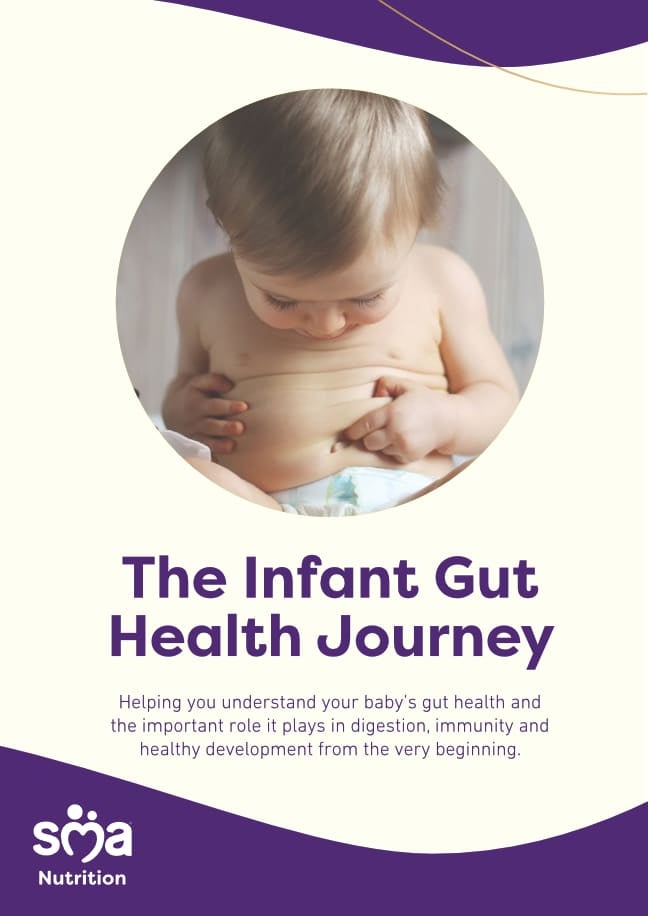
SMA® is here to help you support your baby’s developing gut – explore The Infant Gut Health Journey, a guide by SMA® Nutrition simplifying the science and providing practical advice to support gut health in early childhood.
Watch: Pregnancy and baby gut health videos, tips & expert guidance
Get to grips with infant gut health! Our very own Maude Grant, Nutrition & Scientific Affairs Manager at SMA® Nutrition, explains the importance of infant gut health in this series of videos:
What is gut health and the microbiome?

In this video, Maude Grant explains what it means to have a healthy gut and how good gut health can support long-term immunity.
Does my baby’s gut health really matter?

Understand why your baby’s earliest years, often called the first 1,000 days are especially important for gut health.
Can I make a difference to baby’s gut health during pregnancy?
Food doesn’t just feed you it also helps nourish your gut microbes. Maude Grant talks you through gut health in pregnancy.
What impacts my baby’s gut health?

From birth method, feeding and weaning, to your baby’s first home, Maude Grant decodes the things that can shape your baby’s gut health.
Read: Expert advice & support on pregnancy & baby gut health








The Infant gut health journey: SMA® Nutrition’s guide to infant gut health
Discover SMA’s® expert guide to infant gut health, covering the first 1,000 days, breastfeeding, formula feeding, weaning, and your baby's developing microbiome.
Learn moreFrequently asked questions
Gut health during pregnancy refers to how well your digestive system functions and the balance of beneficial bacteria in your gut (the gut microbiome). These bacteria support digestion, immune function, and nutrient absorption, helping to nourish both you and your growing baby1,2.
Your gut health may play a supportive role in your baby’s early development, particularly through nutrient supply and early immune system preparation1,3. However, it’s just one part of a much bigger picture, your baby’s microbiome continues to develop after birth through feeding, contact, and their environment1,4.
Supporting your gut health doesn’t need to be complicated. Helpful habits include:
- Eating a varied, fibre-rich diet2
- Including fermented foods like live yogurt or kefir2
- Staying well hydrated
- Keeping gently active with walking or pregnancy-safe exercise
Consistency over time is more important than perfection.
A balanced, varied diet helps support both digestion and beneficial bacteria2. Focus on:
- Fruits and vegetables of different colours
- Wholegrains such as oats and brown rice
- Legumes like lentils and beans
- Nuts and seeds
- Foods with live cultures (e.g. yogurt)
Variety supports a more diverse gut microbiome2.
Your baby’s gut microbiome begins developing at birth, when they are first exposed to bacteria from the world around them4,5. From that point onwards, it evolves rapidly throughout infancy and early childhood4,5.
The way your baby is born can influence the types of bacteria they encounter first4. Babies born vaginally are exposed to different microbes than those born by caesarean section4. However, these early differences are temporary—over time, feeding, closeness, and everyday environment play a much greater role in shaping your baby’s gut microbiome5,6.
In the early weeks and months, your baby’s gut is learning to:
- Digest milk efficiently
- Build immune responses3,4
- Increase the diversity of beneficial bacteria4,6
This is a period of rapid change, where the microbiome is actively developing and adapting to support your baby’s growth4,6.
Several everyday factors help shape your baby’s microbiome, including:
- Feeding patterns (breast milk or formula)5,6
- Skin-to-skin contact
- Family interactions and home environment6
- Exposure to pets and surroundings6
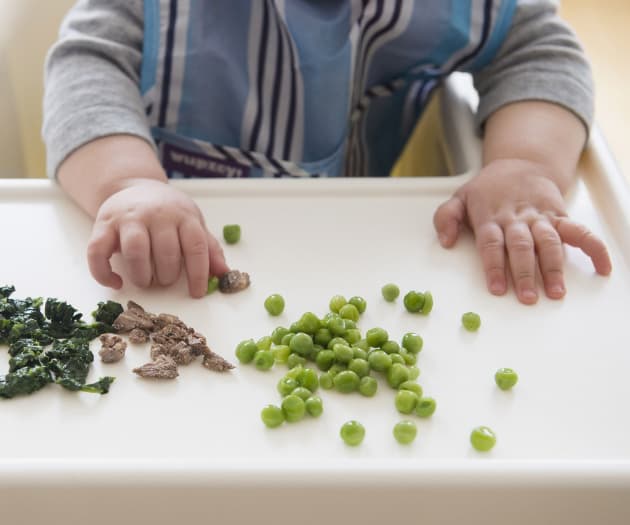
- Gradual introduction of solid foods6
These influences work together over time—there’s no single factor that determines gut health4,6.
Simple, everyday care provides strong support for your baby’s developing microbiome:
- Skin-to-skin contact and cuddling
- Responsive feeding (following your baby’s cues)
- Gentle burping and upright positioning after feeds
- Calm, consistent routines
These natural interactions support both digestion and overall wellbeing.
Different foods provide different types of fibre and nutrients, which nourish different beneficial bacteria6. Offering a wide variety of foods over time helps support microbiome diversity and encourages your baby to explore new tastes and textures6.
Most people can support gut health through diet and everyday care. Foods like yogurt and kefir naturally provide beneficial bacteria2. If you’re considering supplements for yourself or your baby, it’s best to speak to a healthcare professional for personalised advice.
There’s no single perfect approach. Gut health develops gradually and naturally over time1,4,6. A varied diet, gentle routines, and responsive care all play a role. Every journey is unique, and that’s completely normal.
Yes, your baby’s microbiome continues to grow and evolve throughout childhood4,6. Early experiences are important, but development is ongoing and shaped by diet, environment, and everyday life4,6.
- Koren, O., Konnikova, L., Brodin, P., Mysorekar, I.U. and Collado, M.C. (2024) ‘The maternal gut microbiome in pregnancy: implications for the developing immune system’, Nature Reviews Gastroenterology & Hepatology, 21, pp. 35–45. Accessed July 2026. Available at: https://www.nature.com/articles/s41575-023-00864-2. Accessed July 2026.
- Strobel, K.M., Juul, S.E. and Hendrixson, D.T. (2023) ‘Maternal nutritional status and the microbiome across the pregnancy and the post-partum period’, Microorganisms, 11(6), p. 1569. Available at: https://www.mdpi.com/2076-2607/11/6/1569. Accessed July 2026.
- Gao, Y. et al. (2022) ‘Maternal gut microbiota during pregnancy and the composition of immune cells in infancy’, Frontiers in Immunology, 13, 986340. Available at: https://doi.org/10.3389/fimmu.2022.986340. Accessed July 2026.
- Selma-Royo, M. et al. (2024) ‘Birthmode and environment-dependent microbiota transmission dynamics are complemented by breastfeeding during the first year’, Cell Host & Microbe, 32(6), pp. 996–1010.e4. Available at: https://pubmed.ncbi.nlm.nih.gov/38870906/. Accessed July 2026.
- Coker, M.O. et al. (2021) ‘Infant feeding alters the longitudinal impact of birth mode on the development of the gut microbiota in the first year of life’, Frontiers in Microbiology, 12, 642197. Available at: https://doi.org/10.3389/fmicb.2021.642197. Accessed July 2026.
- Andrés, J.B. and López-Cortés, A. (2025) ‘Microbial beginnings: determinants and disruptions of the neonatal microbiome’, Frontiers in Microbiology, 16, 1672780. Available at: https://doi.org/10.3389/fmicb.2025.1672780. Accessed July 2026.