


Introduction
Your midwife is about to become your new best friend - or maybe you'll be lucky enough to have a whole team! They're there to support you and keep you informed about all the amazing changes happening throughout your pregnancy. From the exciting moments like hearing your baby's heartbeat, to the tougher ones (hello, morning sickness!), they'll offer advice and give you all the information you need to help you and your little one stay healthy.
Midwife appointments are your chance to ask questions, talk through any worries, and get the reassurance you need so you can feel calmer and more relaxed throughout your pregnancy.
Your first midwife appointment – also known as your booking appointment – is a chance to get to know your midwife and start planning your pregnancy care. This usually happens before you are 10 weeks pregnant,2 and from there you’ll have a series of antenatal appointments designed to check that you and your baby are on the right track, and to make sure you have the advice and information you need at every stage.
What happens at the first midwife appointment?
You’ve found out you’re pregnant, you’ve contacted your GP, and they’ve made you a booking appointment with a midwife – so what happens next?
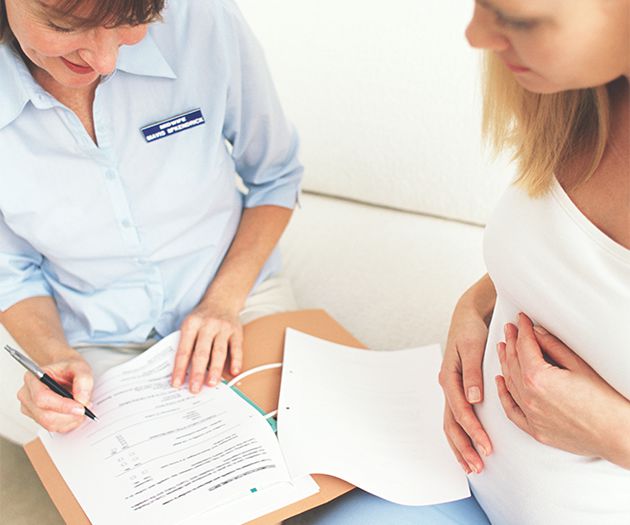
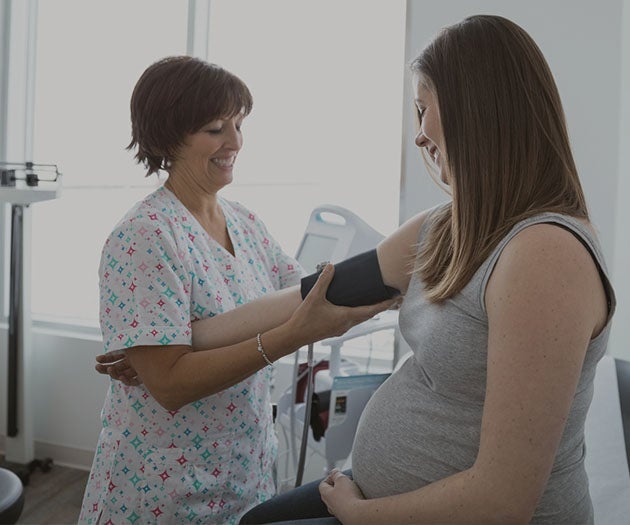
Your first midwife appointment usually takes about an hour, and during this time, they’ll chat to you about your health, family history, last period, and how you’re feeling so far.3 They will also do a few simple checks like measuring your height and weight, checking your blood pressure and taking blood and urine samples.
You’ll be given information about your pregnancy care, screening tests, and what to expect over the following months – including booking in your dating scan.
It’s nothing to worry about and it’s a great opportunity to ask questions, share any worries, and get support right from the start.
What questions will my midwife ask?
To make sure you get the best care all the way through your pregnancy, your midwife will want to find out more about you and your lifestyle. They’ll chat to you about your medical history, as well as the biological father’s – just to see if there’s anything that might affect your baby’s health.
Other things they might ask you:
- How you’re feeling physically and emotionally
- Your diet and lifestyle
- Any previous pregnancies
- Any medicines or supplements you take
- Any allergies you have
- Your work and what it involves
- The support you have at home4
What tests and checks are done at the first appointment?
To help keep you and your baby healthy, your midwife will do some routine checks. These usually include measuring your blood pressure, height, and weight, and taking blood and urine samples. If there’s a risk, you may also be offered screening for sickle cell disease and thalassaemia.5
At the end of your appointment, your midwife will give you your maternity notes – you’ll need to bring these with you to every visit.6 They’re packed with details about your appointments, test results, and handy phone numbers for your midwife or maternity unit.
Just a heads up, a lot of it’s written in shorthand, so, if you’re not sure what’s what, our handy guide on maternity notes has you covered.
Will I get a due date at this appointment?
Your midwife can’t give you a definitive due date at this first appointment, but they can give you an estimated date based on your last period.
Don’t worry, your due date will be confirmed at your dating scan, which usually takes place between 10 and 14 weeks.7 In the meantime you could try our pregnancy calculator to get a due date, however babies don’t work like clockwork so treat it as an estimate rather than a fixed date.

What happens at follow-up antenatal appointments?
You will have regular check-ups throughout your pregnancy to make sure you and your baby are as happy and healthy as possible.
11-14 weeks (Dating scan): Ultrasound to confirm how far along you are, check your baby’s development, and screen for conditions like Down’s syndrome.
16 weeks: Midwife checks how you’re feeling, your blood pressure, and urine, and explains the next scan.
18-21 weeks (20-week scan): Ultrasound to check your baby’s physical development. You’ll also be offered the whooping cough vaccine.
25 weeks (for first pregnancies): Midwife measures your bump, checks blood and urine, and asks about your baby’s movements.
28 weeks: Same routine checks. May offer extra screening and discuss how to prepare for labour. Respiratory syncytial virus (RSV) vaccine is offered to protect your baby after birth.
31 weeks (for first pregnancies): Routine checks – bump measurement, blood pressure, urine, and baby’s movements.
34 weeks: Routine checks, plus information about preparing for labour and C-sections.
36 weeks: Routine checks, plus advice on breastfeeding, newborn care, and postnatal wellbeing. They will also check your baby’s position. They will also discuss how to recognise postnatal depression.
38 weeks: Routine checks and discussion about options if your pregnancy goes beyond 41 weeks.
40 weeks (for first pregnancies): Routine checks and discussion about what happens if your pregnancy goes beyond 41 weeks.
41 weeks: Beyond the routine checks, you’ll be told about the options for induction and may be offered a membrane sweep.
42 weeks: If you’ve not had your baby and haven’t chosen an induction, you’ll be offered increased monitoring of your baby.8
How often will I see my midwife during pregnancy?
Quite often. You’ll have regular midwife appointments throughout your pregnancy, though how many you have will depend on whether you’ve had a baby before.
If this is your first pregnancy, you’ll usually have up to 10 appointments. If you’ve had a baby already, you may have around seven. In the interim if you have any questions you could always try our Midwife Live Chat service.
“Walking into my first midwife appointment, I didn’t know what to expect — but it ended up being such a relief. It was the first time everything started to feel real, and having someone listen, reassure me, and explain what would happen next made me feel so much calmer about the whole journey.”
What if I have a high-risk pregnancy – will my appointments be different?
If your pregnancy is classed as high-risk, your midwife may want to see you a little more often than someone with a low-risk pregnancy. You may also be offered extra scans so your baby’s growth and wellbeing can be monitored more closely.
You might be offered extra blood tests and scans if there’s a chance you’re at risk of a particular infection or condition.
Rest assured that any additional tests your midwife recommends will be in the best interests of you and your baby, and you should always know why they’re being offered. It will be your choice whether you want them.
Can I bring someone with me to my appointments?
Of course. If it’ll make you feel more comfortable, you can bring a partner, family member or friend along. Just bear in mind, you may be talking about some personal and confidential things.
Am I allowed time off for antenatal appointments?
Absolutely. If you’re employed, you have the right to paid time off for midwife’s appointments in the UK. This can include antenatal or parenting classes, if they’ve been recommended by a doctor or midwife.9
It’s worth knowing your rights as a pregnant employee.
What questions to ask midwife at first appointment?
Talking honestly to your midwife is one of the most important ways to make sure your pregnancy care meets you and your baby’s needs.
Beyond the questions they’ll ask you about your medical history and how you’re feeling, here are a few things you might want to ask:
- What mental health support is available if I’m feeling anxious, low or stressed?
- What maternity benefits am I eligible for, like prescriptions and free dental?10
- How do I know if something is wrong and what should I do?
You may also find the following useful:
- Bringing a list of questions
- Taking notes
- Asking for something in writing
- Asking for clarification, if something isn’t clear
- Bringing someone else along – like a partner, family member or close friend
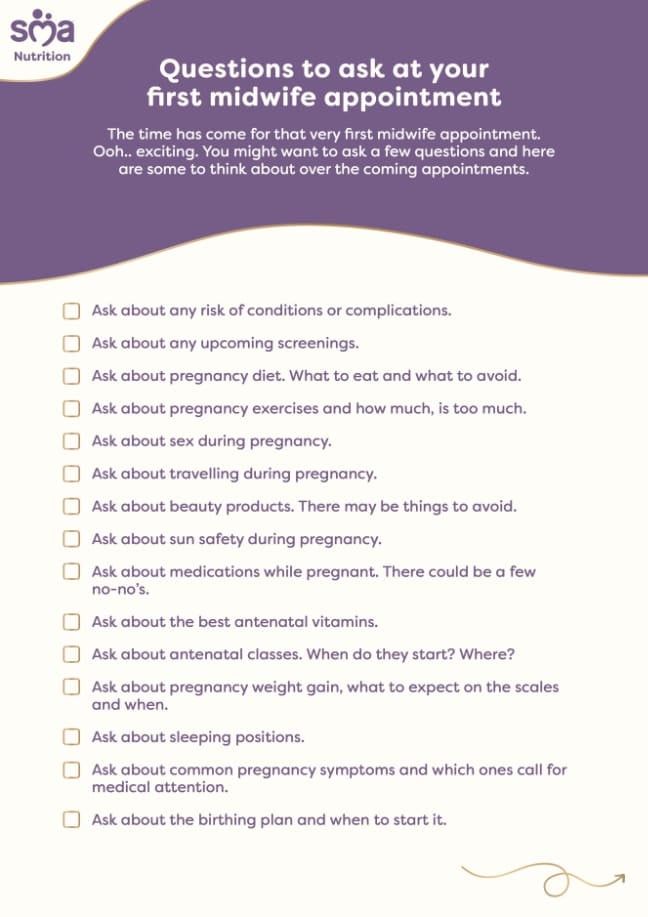
Why not check out our helpful midwife appointment checklist?
Where can I get more support between appointments?
- Midwife or Maternity Unit – You can call your midwife or maternity unit any time of the day or night for urgent concerns.
- Your GP – for urgent concerns or NHS 111 out of hours.
- A list of non-urgent contact numbers will be written in your maternity notes (given to you at your first antenatal appointment).
- NHS.uk – for further information, check out the NHS guide on Your Antenatal Care
- SMA Careline® – our Careline team has access to expert healthcare professionals and are online and on the phone to help answer your questions.
- Midwife Live Chat: Chat online to a real midwife using our Midwife Live Chat service.
- Plus, we have lots of handy articles that may help.

Midwife live chat
As part of our commitment to supporting you on your parenting journey, we’ve partnered with Epical Global to give SMA® Baby Club members access to trusted expert support. You can chat live with a team of expert midwives, available every day from 10am–8pm, to help answer your questions. We’ve also expanded this support to include a dedicated health visitor every Monday from 10am–2pm, and an expert dietitian from Monday to Thursday, 12pm–4pm.
Author
Siobhan Jarzabek
Midwife
Siobhan is a midwife and a Newborn Life Support Instructor with the Resuscitation Council UK. She is passionate about family-led care and is dedicated to providing families with accessible, evidence-based education and information to support informed decision-making throughout their care journey.
Share on